

Relocating to Charlotte
Everything your relocation packet left out
Neighborhoods, real cost of living, the climate nobody warns you about, and what it’s actually like to land here. Free, honest, and written by people who do this every day.
What’s inside
Eleven sections. Everything you need.
Why people are Moving Here
The job market is the headline. Banking still anchors the city: Charlotte is the second-largest US banking center after New York. But the story has expanded. Fintech, healthcare, and energy have all grown serious footprints here. If you got a job offer in one of these industries and Charlotte is on the table, that’s probably how you landed on this page.
Cost of living is another major draw. For those coming from the Northeast, or from other major cities like Chicago, San Francisco, or Miami, Charlotte rent and overall expenses can be pretty attractive. Not cheap, but reasonable.
The climate is a big one too. Charlotte has four real seasons: mild winters that don’t drag on, gorgeous spring weather, and a crisp fall that often stretches into November. Hot and humid summers are forgivable because the rest of the year is so mild.
Then there’s the harder-to-name reason. Charlotte still feels like a city that’s becoming. It’s fast-growing, inviting for relocators, and still settling into its own identity. As you’ll see later in this guide, Charlotte gets compared to a lot of other cities: smaller than Atlanta, feels like Denver did a decade ago, not as trendy as Austin or Nashville. But ultimately, Charlotte.
And the practical reality: you won’t be the only one new to Charlotte. Most of your neighbors and colleagues moved here from somewhere else, too.


What Charlotte is like
It’s bigger than people expect. Charlotte is the 14th-largest city in the US by population. The metro area is closing in on 3 million. People moving here from coastal cities often picture a small Southern town and arrive surprised by the skyline, the traffic, and the sprawl. People moving here from genuinely small towns arrive surprised in the other direction.
Money is here, but it’s quiet. Banking built modern Charlotte: Bank of America is headquartered here, Truist and Wells Fargo have major operations here, and the broader financial sector employs tens of thousands. There’s also healthcare wealth, professional sports money (Panthers, Hornets, Charlotte FC), and NASCAR money concentrated north of the city. But the culture isn’t flashy about any of it. You’ll see expensive cars and watches in Uptown and South End, but not the way you’d see them in Miami or LA. The wealthy neighborhoods are leafy and quiet. Old money in Charlotte doesn’t announce itself, and new money has mostly taken its cue from old money.
It’s more diverse than its reputation. Charlotte is one of the most racially and culturally diverse cities in the South. Roughly 34% of residents are Black, 17% Latino, and there are significant South Asian, West African, and East Asian communities. The international population has grown quickly over the last fifteen years. If you arrive expecting a homogeneous Southern city, you’ll be wrong.
The South, softened. Yes, Charlotte is a Southern city. People hold doors. Strangers chat in line. There’s biscuits and gravy on a lot of brunch menus, though it’s not as good as your grandma’s. But the heavy Southern stereotypes don’t really apply here. You won’t hear “bless your heart” much. Charlotte doesn’t have a distinct accent the way Charleston or Savannah do. The hospitality is warm but not sticky.
Outdoor access is excellent, even if Charlotte isn’t Asheville. The greenway system runs through the city: most weekends, the Little Sugar Creek Greenway and the Rail Trail are packed with walkers, runners, and bikers. The US National Whitewater Center is fifteen minutes from Uptown. Crowders Mountain is forty minutes. Lake Norman is half an hour. Pisgah National Forest is two hours west. The Atlantic coast and Wilmington are three and a half hours east. Mountains in one direction, ocean in the other, both reachable on a weekend.
Brewery culture functions as community infrastructure. Charlotte has thirty-plus breweries, and they operate as community living rooms more than nightlife venues. People bring kids and dogs. Breweries host trivia, run clubs, yoga, farmers’ markets, and birthday parties. If you’re coming from a city where bars are exclusively for nighttime, the daytime social life happening at Charlotte breweries will surprise you.
Charlotte doesn’t have a defined identity, and that’s probably why it works. I’ve spent three years trying to name what makes Charlotte uniquely Charlotte. I can’t quite do it. I asked my neighbor, who’s lived here fifteen years. He couldn’t name it either. Austin is weird. Asheville is crunchy. Nashville is music. Charleston is history. Charlotte doesn’t have an equivalent. But I’ve come to think that’s part of the appeal. Without a rigid identity to fit into, people from anywhere fit. The lack of a defining edge leaves room for everyone.


Where people are moving from
These are the cities our clients most often relocate from. Several of them are cities I’ve lived in or worked in myself. What follows is what relocators from each city tend to say, drawn from real conversations about what the move actually felt like.
Atlanta Guide coming soon
If Atlanta is your reference point, Charlotte will feel familiar. Smaller, slower, less flashy. Charlotte is what Atlanta was a couple of cycles ago, before the sprawl ate the suburbs and the commute ate the day. The Southern hospitality lands the same. The food scene is comparable, if not as deep. The professional culture overlaps significantly because so many people work for companies with offices in both cities.
Atlanta transplants aren’t moving for the math. The cost difference between city of Atlanta and city of Charlotte is negligible. They’re moving because they don’t want to lose three hours a day to 285 and 75. Charlotte has a downtown (though we call it Uptown) you can walk across, an airport you can get to in fifteen minutes from most neighborhoods, and money that doesn’t ask to be noticed.
What Atlanta transplants tend to say, once they’ve been here a few months: Charlotte feels downright homey by comparison. Smaller, easier, less sprawl to fight. They came expecting a downgrade in city energy and found they didn’t miss what they left.
New York
Moving from New York requires the biggest mental shift of any city on this list. Transplants are intentionally trading hyper-speed for a slower pace, milder seasons, and significantly more space for less money.
You will miss New York—the lived-in character of your Harlem block, your favorite SoHo bar, or the Brooklyn barista who knew your order. Charlotte has nothing like that, but the sheer volume of New Yorkers moving here proves it’s a tradeoff they are willing to make. The hardest practical adjustment is shifting back to a car-dependent lifestyle; while the LYNX Blue Line services central neighborhoods, you will need wheels.
The consensus from people moving from New York to Charlotte: they traded the subway for a steering wheel, the rent for a savings account, and they’d do it again. The biggest surprise wasn’t the financial relief—it was how much better their social life got when leaving the apartment stopped being a production.
There is no single neighborhood where New Yorkers land. Some crave NoDa’s grit, others want Plaza Midwood’s walkable bungalows, and many head straight to Pineville for a three-bedroom townhome with a garage that costs less than their old studio. The one thing they almost all agree on? Not Uptown.
Relocating from New York? Read the guide →
Washington, DC / DMV Guide coming soon
DMV transplants are some of the easiest to relocate. The professional culture overlaps almost entirely with Charlotte’s: federal contractors, consultants, healthcare and policy professionals, military-adjacent careers, and a lot of two-income households tired of paying DC prices for what they’re getting. People are well-educated, well-traveled, and used to navigating a real city. Charlotte fits comfortably.
The biggest gains: dramatically lower housing costs and weekends that feel like weekends instead of a recovery shift. The biggest losses: the museums, the Metro, and easy proximity to two coasts and an international airport that goes everywhere. Charlotte Douglas gets you most places direct, but it’s not Dulles.
On traffic: The DC region ranked worst in the country for congestion in 2025, with drivers losing the equivalent of 71 days a year to sitting still. Charlotte’s average commute runs closer to 25 minutes. For a lot of DMV transplants, that line item alone closes the conversation.
Charlotte has its own rush-hour gripes, but DMV transplants tend to describe Charlotte as a smaller, lower-cost version of the DC area. They mean it as a compliment.

Miami Guide coming soon
Let’s be honest. Charlotte cannot compete with Miami. Not on culture, not on weather, not on food, not on energy, not on views, not on international presence, not on any axis a Miami person would actually use to compare cities. If you’re moving from Miami to Charlotte, there’s essentially one reason: housing costs roughly half of what you’re paying now, and the job market is arguably better. That’s the pitch. We’re not going to pretend it’s bigger than that.
A client once told me he could sit on his Miami terrace and watch dolphins jumping in the morning. I told him I had a view waiting for him in Charlotte too. He’d walk out his front door in NoDa and see the karaoke place he didn’t know yet but soon would. We laughed. He moved anyway. He’s still here.
What you’ll miss: everything. The water. The food. The Cuban coffee. The Colombian neighbors. The Haitian neighbors. The Venezuelan neighbors. The neon. The pulse. The way the air feels at 11 PM in October. You won’t find any of that here. Charlotte isn’t trying to be Miami. It’s a different kind of city for a different kind of chapter.
What you’ll gain: a paid-down mortgage instead of a rent payment that haunts you, a job market that’s deeper and less seasonal, four real seasons including a winter that’s actually winter, and the kind of quiet weekend that doesn’t exist in Miami. If you want that trade, Charlotte will hold it for you. If you don’t, you should stay in Miami. You’ll be happier there.
While this guide focuses on relocating renters, if you’re relocating from Florida to Charlotte and planning to buy, here’s a nice surprise: you’re likely to see a big drop in your home owners insurance. Florida is the most expensive state in the country for home insurance, averaging around $7,500 a year, and dozens of insurers have pulled out of the market entirely. North Carolina averages closer to $2,300. Charlotte sits inland, far from hurricane risk. For a lot of Florida transplants, that line item alone changes the math.
Chicago Guide coming soon
People relocating from Chicago are almost universally excited about space, sunshine, and a winter that doesn’t actively try to kill them. Most grew their careers there, got promoted into a lifestyle they didn’t love, and are choosing Charlotte as the correction. Same career, more breathing room.
The trade is real: you give up world-class architecture, the lake, the food scene, and the transit. You get warmer winters, a lower cost of living, a shorter commute, and the ability to be outside year-round.
One thing Charlotte can’t give back: the L. People leaving Chicago talk about almost everything else as a reasonable trade. The transit is the grief that doesn’t go away.
Boston Guide coming soon
Boston transplants come for the climate, the cost, and the space — and the career often comes along. Many Boston employers have Charlotte offices now, and remote work has made the rest negotiable. A lot of people arrive with a job already in hand and half their old office already here. You’re rarely the only ex-Bostonian in the building.
The cultural adjustment is real but quick. Boston is direct. Charlotte is polite. The first time a neighbor asks how you’re settling in and actually waits for the answer, you’ll feel the difference.
A note from former Bostonians on driving: they’d take aggressive-and-predictable over polite-and-unpredictable drivers any day. At least in Boston you knew what was coming.
San Francisco and the Bay Area Guide coming soon
This is the biggest cost-of-living delta on this list. Bay Area transplants are usually tech professionals making a real rethink of what life is supposed to cost.
What you gain: housing you can actually afford. A path to ownership that doesn’t require an inheritance. Schools that don’t require five figures a year to be decent. Weather that’s less gray than people expect.
What you lose: the food, the politics, the tech ecosystem density, and a transit system that, even at its worst, beat Charlotte’s. Plan to drive.
What people who made the move actually say: their money goes about twice as far, and they didn’t fully believe it until they signed a lease.
On the career ceiling: Charlotte is a finance town, not a tech town. People in big tech roles think hard about whether the next job exists here before they commit. Most decide the trade is worth it. Remote work has made the hedge easier — you can take the Charlotte cost of living without fully leaving the Bay Area job market.
Denver Guide coming soon
Everyone draws the comparison. When someone says “Charlotte reminds me of Denver ten years ago,” I feel it. I’m from there. Both mid-sized, fast-growing, drawing young professionals, building real downtown density. Both have brewery cultures that function as genuine social infrastructure. Charlotte is earlier in the curve.
But the cities work differently. Denver is built around the mountains. Red Rocks, snowboarding, river days, weekend trips to Aspen and Telluride. A Denver life is shaped around access to those things, and most Denver people wouldn’t have it any other way.
Charlotte has mountains two hours west and a different relationship with them: occasional rather than central. The breweries, trails, lakes, and music are all here. The outdoor life exists. It just doesn’t run your weekend by default.
A few things Denver transplants name as genuine surprises: there’s no overnight cooldown in summer. The humidity is real and takes a full season to calibrate to. Beers hit differently at sea level. And the mountains, when you visit, seem far away even though they’re only two hours.
Some distances aren’t geographic.
The pattern, city by city
What people expect to miss when they move to Charlotte and what they actually miss are rarely the same thing. The food scene, the energy, the culture — those come up in the first conversation. What comes up six months later is the commute. Charlotte gives most people their evenings back. That turns out to matter more than almost anything else on the list.

Where to live
Overwhelmingly, these neighborhoods are where relocating renters want to live. They’re central, lifestyle-oriented, and have the biggest concentration of recently built apartments. Here’s a summary of each. If you want the deep dive, there’s a full collection of neighborhood guides on the site.

Uptown
Urban Core Sports & Entertainment Walkable $$$$
Charlotte’s skyline district, where office towers, museums, sports venues, and parks make up the heart of the city. Once a nine-to-five business district, Uptown has quietly become a place people actually live. Walk to football games, concerts, rooftop bars, and some of the city’s best public spaces without ever getting in a car.
South End
Walkable Light Rail Social $$$$
One of Charlotte’s most walkable neighborhoods, built around the Rail Trail. South of Uptown and just outside I-277, South End blends converted industrial buildings with modern apartment communities, popular restaurants, cocktail bars, and boutiques. Atherton Mill anchors the neighborhood with patios overlooking the Rail Trail.
NoDa
Arts District Light Rail Walkable $$
Charlotte’s historic arts district. Colorful murals, live music venues, and a creative neighborhood spirit, just north of Uptown. Walkable streets, light rail access, and a growing mix of modern apartment communities make NoDa one of the most dynamic places to live in the city.
Plaza Midwood
Vibrant Walkable Historic $$$
One of Charlotte’s most distinctive neighborhoods. Colorful murals, vintage shops, and independently owned restaurants centered on Central Avenue, surrounded by historic residential streets. Walkable, dog-friendly, and full of local energy.
LoSo (Lower South End)
Near South End Breweries Light Rail $$$
People land in LoSo for one of two reasons: they want a more relaxed alternative to South End, or they’re looking for better value nearby. Same proximity to the core neighborhoods and the light rail, with less pressure and more space for the price. Extremely dog-friendly. Most breweries welcome dogs, and a few even pair with a dog park.
West End
Historic Community Near Uptown $$
One of Charlotte’s most historic neighborhoods, with deep cultural roots and close proximity to Uptown. A longtime center for Black culture, business, and education, now seeing new investment alongside long-standing homes and businesses. Offers more space and value near the city core, within a neighborhood that carries a strong sense of identity and history.
Optimist Park
Near NoDa Light Rail Food Hall $$
Where you go when you want something good, fast, and worth leaving your apartment for. Anchored by Optimist Hall and tucked between Plaza Midwood, NoDa, and Uptown, it’s one of Charlotte’s easiest “let’s just go here” decisions.
North End
Creative Community Food Hall $$
Centered around the massive Camp North End hub, North End is an ideal neighborhood for renters seeking a creative, industrial-chic vibe just minutes from Uptown Charlotte. It offers a unique mix of newly developed apartments and converted lofts, placing residents steps away from a thriving food truck scene, local breweries, and extensive public art displays. It is a rapidly growing area perfect for young professionals and newcomers who want an energetic, community-driven lifestyle with an easy commute to the city center.
University City
20 Min to Uptown Light Rail $$
Centered on UNC Charlotte, this area swaps local neighborhood charm for pure convenience and corporate infrastructure. It functions primarily as a launchpad for students and professionals who want to live exactly where they work or study. While it is not a destination for weekend lifestyle seekers, it compensates with extensive light rail access, massive suburban shopping complexes, and competitive rental rates.
SouthPark
Shopping Luxury $$$$
Upscale, high-energy neighborhood that serves as Charlotte’s premier retail and business hub outside of Uptown. Anchored by SouthPark Mall, the area perfectly blends a bustling corporate center with tree-lined streets, high-end dining, and vibrant nightlife. For renters, it offers a sophisticated lifestyle where walkable convenience meets top-tier apartments and quiet residential charm.
Dilworth
Established Walkable Trees $$$$
Charlotte’s tree-canopy neighborhood. Walk under mature oaks past historic bungalows, landing at one of the newest high-rises in the city. As Dilworth has added new housing options, more South End renters are migrating over for the same walkability with a slightly more residential feel. Latta Park, a strong restaurant and shop concentration, and a quieter pace than its neighbor to the west.
Full guide coming soon
Midtown
Near Uptown Trader Joe’s Hospital District $$$
If you want to walk to Trader Joe’s, choose Midtown. Convenient to the hospital district, with a great stretch of restaurants near 7th and Pecan and Independence Park for a quick outdoor break from city life. The LYNX Gold Line streetcar runs through the neighborhood for easy access to Plaza Midwood.
Full guide coming soon
Ballantyne
Upscale Suburb $$$
Corporate south Charlotte. Where colleagues tell their colleagues to live. Suburban density, walkable in the immediate Ballantyne corporate village, less so elsewhere. Rental rates comparable to Uptown.
Full guide coming soon


Charlotte cost of living
When it comes to the cost of living, your perception of Charlotte depends entirely on where you are coming from.
If you are relocating from one of Charlotte’s biggest “sending” metros, like New York City, Washington D.C., Boston, or San Francisco, the financial relief is immediate. Most people migrate here for economic optimization; your dollar stretches significantly further in housing, taxes, and daily expenses.
The percentages below come from NerdWallet’s cost-of-living calculator, which uses the C2ER cost-of-living index, the same index used by HR departments, relocation companies, and corporate finance teams. We assumed a $100,000 income for each comparison to keep things consistent.
Charlotte vs. top cities people relocate from
| Coming from | Overall | Housing | Transport | Food | Entertainment | Healthcare |
|---|---|---|---|---|---|---|
| New York (Manhattan) | 58% lower | 80% lower | 15% lower | 12% lower | 22% lower | 19% lower |
| San Francisco | 38% lower | 60% lower | 29% lower | 12% lower | 16% lower | 7% lower |
| Boston | 32% lower | 54% lower | 4% lower | 1% lower | 13% lower | 14% lower |
| Washington, DC | 26% lower | 51% lower | 4% lower | 3% lower | 10% lower | 4% lower |
| Miami | 15% lower | 36% lower | 1% higher | 6% lower | 5% lower | 40% higher |
| Chicago | 14% lower | 30% lower | 3% lower | 1% lower | 8% lower | 0% |
| Denver | 8% lower | 16% lower | 2% higher | 0% | 9% lower | 3% lower |
| Atlanta | 7% higher | 22% higher | 3% lower | 1% higher | 5% higher | 18% higher |
Based on C2ER data via NerdWallet’s calculator June 2026, normalized to a $100,000 household income. Your situation will vary by neighborhood, lifestyle, and household size.
Reading the data
A few observations on what the numbers actually say:
Housing is the entire story. For every city on the list, the housing savings dwarf everything else. If you’re moving from Manhattan, you’re saving 80% on housing and 12-22% on other categories. The other categories matter less than people expect.
Charlotte is more expensive than Atlanta. This surprises most people. Atlanta city proper has gentrified hard over the last decade, and Charlotte caught up. If you’re moving from Atlanta, you’re not coming for the math. You’re coming for the commute, the airport, and the smaller-city pace. The financial difference is essentially flat.
Miami healthcare costs are notably lower than Charlotte’s. Charlotte healthcare measures about 40% higher than Miami’s on the C2ER index. If you have ongoing medical needs and you’re moving from Miami, it’s worth checking that your providers and prescriptions translate over before you move.
Transportation savings are smaller than you’d expect. Charlotte is more car-dependent than NYC, SF, Boston, DC, Chicago. But transportation costs in those cities aren’t just public transit, they include parking, ride-shares, congestion charges, and the actual cost of owning a car in a dense market. Net out, Charlotte saves a little on transportation, but not as much as the public-transit narrative would suggest.
Healthcare and food are roughly comparable across most cities. Don’t expect meaningful savings here. The headline cost-of-living number is almost entirely a housing story.
However, Charlotte is not a bargain city in the abstract.
Driven by a massive population boom, local prices have risen sharply. If you look at the top 20 cities people migrate from, only about half are more expensive than Charlotte. If you are moving from a midwestern hub like Indianapolis or Cleveland, you will actually find Charlotte’s housing market and lifestyle costs to be visibly higher.
The Takeaway: There is no universal “average” story for Charlotte’s cost of living. Your financial reality depends on your starting point. Use our calculator below to input your current city and map out your specific financial narrative.
Cost of Living Calculator
In Charlotte, you’ll need a household income of:
$73,600
Cost of living is 26.4% lower overall.
Don’t see your city? We’ve listed the top sending cities here. NerdWallet has a much wider list →
Transportation

You're going to want a car in Charlotte. If you opt for a neighborhood right on the LYNX Blue Line, there may be an exception. But overwhelmingly, most people in Charlotte have a car.
The LYNX Blue Line runs roughly north-south from UNC Charlotte through NoDa, Uptown, South End, and ending near the I-485 corridor in the south. If you live along the line and work along the line, car-free is genuinely possible. For everyone else, plan on a car.
Walkable neighborhoods. Uptown, NoDa, and South End offer real walkability with light rail access. Plaza Midwood is walkable within itself, but without light rail, you're either in the neighborhood or in a vehicle (yours or a rideshare).
The car-free experiment. The NoDa and Optimist Park corridor (sometimes called the Mill District) is currently the most ambitious test of car-light living in Charlotte. Charlotte developer Space Craft has led the experiment, first with The Joinery, then with Oxbow (389 units along North Davidson, opening with just 136 parking spaces for nearly 600 residents), and soon Cordo (287 units with just 107 parking spaces opening in 2027). All three buildings sit steps from the Blue Line.
The buildings emphasize design and amenities over parking. For example, Joinery residents have access to Teslas, e-bikes, and e-scooters for rent through the building. The savings from building less parking, roughly $25,000 to $50,000 per garage space, get channeled into walkable retail (first-floor shops and restaurants), the pedestrian-only Joinery Alley connecting the two buildings, and an extension of the Cross Charlotte Trail. Sprouts Farmers Market recently opened just north of there in NoDa, adding the grocery anchor that the corridor was missing.


Worth knowing
The car-optional model isn't friction-free in practice. A meaningful share of residents lease these buildings while still owning cars, which has put real pressure on street parking in the surrounding residential blocks. Three years ago you could find a spot easily anywhere in Optimist Park. Today it's noticeably harder. The buildings work beautifully for renters who genuinely want to live without a car. They work less well for renters who plan to own one anyway, and they create real costs for the homeowners next door.
The airport. Charlotte Douglas International (CLT) is a major American Airlines hub. Direct flights to most US cities, several international destinations. About fifteen minutes from Uptown on most days, longer during rush hour. Easy access from I-77 and I-85.
LYNX Gold Line streetcar. A short streetcar line connecting Uptown to Midtown and Plaza Midwood. More of an extra than a primary transit option, but useful if you live in Midtown and work Uptown.
Charlotte Area Transit System (CATS). Bus service throughout the city. Functional, but not what most renters rely on. The Blue Line gets the vast majority of transit ridership.
A note on the rideshare options. Uber and Lyft are abundant and reasonably priced compared to coastal cities, and Waymo just rolled out their driverless cars in Charlotte. If you live in a walkable neighborhood and occasionally need a ride to the airport or to a meeting outside walking range, rideshare can substitute for a car more easily than in most US cities. It's a real option.
From Charlotte, you can reach...
| City | Drive Time |
|---|---|
| Asheville | 2 hours |
| Raleigh | 2.5 hours |
| Charleston | 3 hours |
| Wilmington | 3.5 hours |
| Hilton Head | 4 hours |
| Atlanta | 4 hours |
| Washington DC | 6 hours |
| Nashville | 7 hours |
| Pittsburgh | 7 hours |
| Philadelphia | 8 hours |
| New York City | 10 hours |
The location math
Over 50% of the US population lives within a one-day drive from Charlotte. Mountains in one direction, ocean in the other, and most of the Eastern Seaboard within reach on a long weekend. For a city that requires a car, the location compounds well.
What the roads will not tell you
The Queens and Queens multiverse. Charlotte's obsession with the word "Queens" is a local running joke. In the Myers Park neighborhood, Queens Road intersects with Queens Road. It also intersects with Queens Road West. To make matters worse, there are multiple "Queens and Queens" intersection points throughout the area. If you tell a GPS to go to Queens Road, it will simply give up.
Exit 3A: The ultimate Frogger simulator. A genuine doozie, and job security for rideshare drivers. The merge at I-277's Exit 3A is so universally hated that a local software engineer turned it into an actual video game. Designed in the 1960s for about 2,100 cars a day, Exit 3A now handles over 12,000. To take the exit toward NoDa, drivers must cross three full lanes of heavy traffic in a span of just 200 feet, while incoming highway traffic simultaneously tries to cut across in the exact opposite direction.
The Sharon / Sharon / Sharon Paradox. If you survive the Queens loop, you will likely run into the "Sharon" zone. In South Charlotte, you can stand at the intersection of Sharon Road and Sharon Amity Road. If you keep driving, Sharon Road turns into Sharon Road West, which is entirely different from Sharon View Road, Sharon Lane, and Little Sharon Road. Much like the Queens riddle, it leaves newcomers completely disoriented while locals just shrug.
The I-77 to I-277 Lane Sweep. Taking I-77 South to get into Uptown requires an immediate, high-stakes drag race. The moment you merge onto the highway from the far-left lane, you must immediately battle your way across multiple lanes of fast-moving traffic to reach the right-hand exit for I-277. Once you finally claw your way onto 277, the highway instantly demands that you cut all the way back across to the left to catch the Church Street exit. It requires aggressive lane-weaving that feels entirely personal.
The Identity Crisis Streets. Charlotte planners love to change a street's name without changing the actual road. A prime example is the continuous stretch of asphalt that completely changes identities as you drive straight through it. The Morehead-Queens-Providence stretch is a real doozie. You can drive in a completely straight line near I-77 on West Morehead Street, watch it smoothly transition into East Morehead Street through Dilworth, and then, without a single turn, morph into Queens Road. Just as you get used to that, it briefly shifts identities into Providence Road before wrapping up its chaotic journey as Caswell Road.
Winter, Pollen, Summer, Fall.
Winter
mild & short
Pollen
yes, a season
Summer
humid, no cooldown
Fall
the best 3 weeks
Here's what to expect from each.
Winter. Mild and short. Daytime temperatures usually in the 40s and 50s, occasional drops into the 30s. Real cold is rare, snow is rarer. When snow does come, the city does not cope well. Two inches in the forecast closes schools and most of the city. Six inches empties grocery store shelves and turns local news into wall-to-wall coverage that produces names like Snowpocalypse, Snowmageddon, and Snownami. We had a true snowstorm in January that shut the city down for about a week. We may not see another for a decade. We may see one next year. Charlotte does not know how to predict its own winters.
Pollen. Real season. Late March through early May. Pine and oak pollen coat cars, patios, sidewalks, and anything left outside for more than a few hours in a layer of yellow-green dust. People who have never had allergies in their lives suddenly find themselves congested and itchy-eyed in their first Charlotte spring. Locals have a name for it: Charlotteitis. Charlotte routinely ranks among the worst cities in the country for seasonal allergies, partly because it's a City of Trees and partly because a longer Southern growing season stretches pollen from late January well into the fall. If you're prone to seasonal allergies, plan for it. If you're not, plan for it anyway.
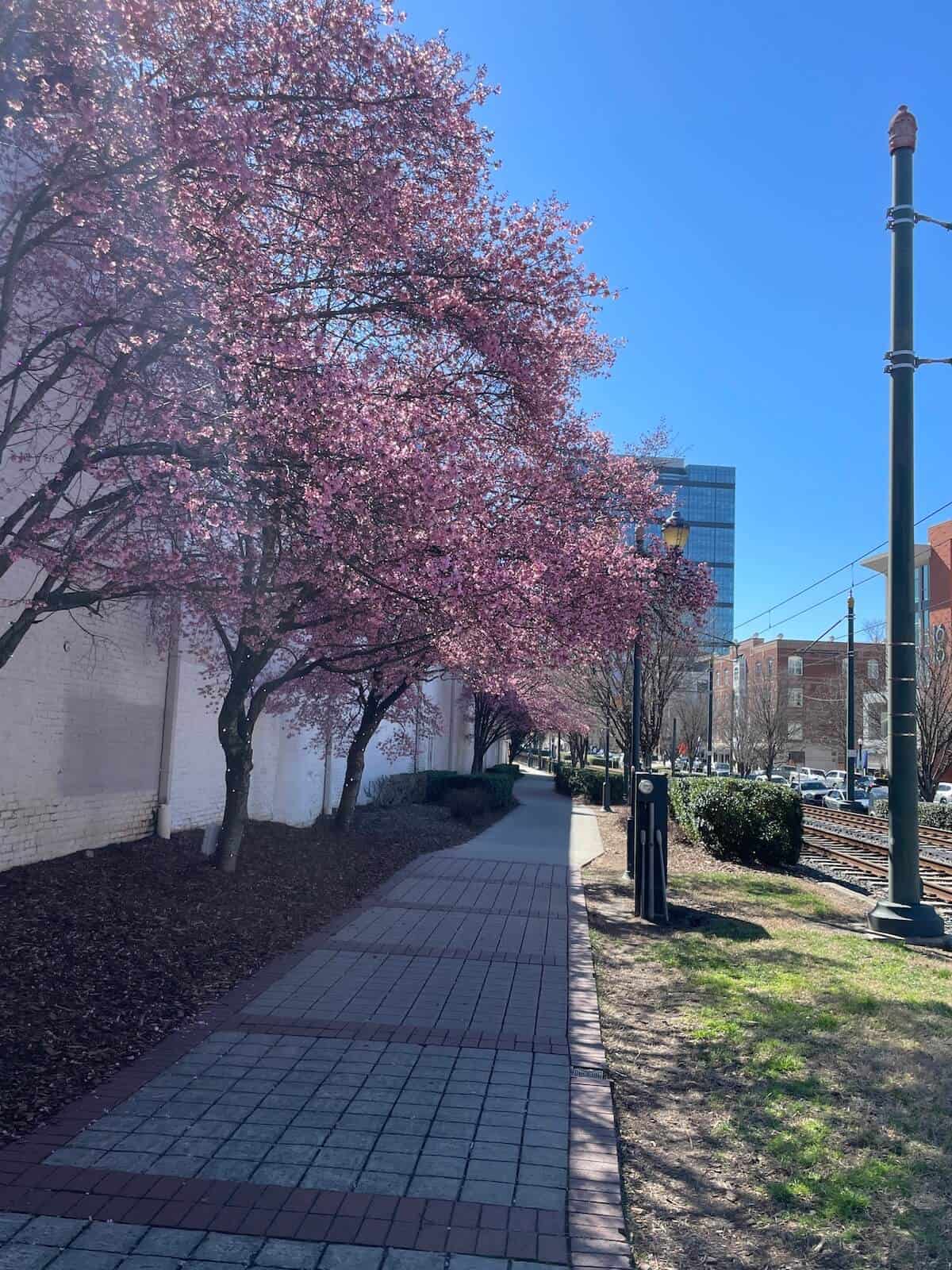
The redemption: cherry blossoms and dogwoods explode across the city from late February through early April. Myers Park, Dilworth, and Plaza Midwood get genuinely beautiful. The Little Sugar Creek Greenway runs through some of the densest blooms. You can walk under a canopy of pink and white petals for blocks. Allergies are the cost of admission. It's worth it.
Summer. Warm and humid in a way you'll feel within five minutes if you're coming from a dry climate. Temperatures regularly hit the 90s from June through August, with heat index often pushing past 100 because of the humidity. The bigger surprise for Denver, Bay Area, and Boston transplants: there is no overnight cooldown. It's hot during the day and hot at night. You don't get the cool-down once the sun sets. Most people adjust. Some people never do.
Fall. The best three weeks of the year. Crisp mornings, warm afternoons, low humidity, colors turning across the canopy. Restaurants put their patios back into rotation. The greenways fill up. Everyone you know talks about how perfect the weather is. Three weeks, usually mid-October to early November. Then it's over and it gets cold-ish for a few months until pollen starts the cycle again.
A note on rain. Charlotte gets more rain than people expect. Brief but heavy summer thunderstorms. Long steady soaking rains in spring and fall. If you're coming from the Southwest or Southern California, the amount of rain will surprise you. If you're coming from the Pacific Northwest, you'll feel right at home.
Practical logistics
A few practical things to handle after you move.
Healthcare. Charlotte has two major hospital systems: Atrium Health and Novant Health. Both have multiple hospitals, urgent cares, and specialty centers throughout the metro. Most insurance plans work with one or both, but coverage varies, verify your plan's network before you commit to providers. If you have specialists, ongoing care, or specific prescriptions, line up your new providers before your move so there's no gap in care.
Driver's license and vehicle registration. North Carolina requires you to switch your license within 60 days of establishing residency. Vehicle registration also has a 60-day window, plus annual inspection and emissions checks.
DMV heads-up
Charlotte's DMV has been rated among the worst in the country. In 2025, the very worst for wait times and customer complaints. Plan accordingly. Bring patience, a charged phone, and snacks.
Insider tip
NC offers online appointment booking at ncdot.gov. If you don't see an appointment for your closest DMV location, look further out from the city center. If you can get one within an hour or so drive, you may actually save time versus waiting for hours as a walk-in. If you have an appointment, you'll be in and out.
Schools. Most of the city of Charlotte is served by Charlotte-Mecklenburg Schools (CMS), one of the larger urban school districts in the country. Some southern suburbs fall under Union County or Cabarrus County school systems. School quality varies neighborhood to neighborhood, and the easiest way to evaluate the school serving a specific address is GreatSchools.org, which has a school finder tool.
If schools are central to your move, it's worth thinking about district boundaries early in your apartment search. We can help orient you to which buildings sit in which school zones, but specific school decisions are yours to make with the resources designed for it.
Taxes and residency. North Carolina has a flat state income tax. The current rate is 3.99%, and it's scheduled to decrease further to 3.49% beginning in 2027. There is no local income tax in Charlotte. Sales tax runs approximately 8.25% (state plus Mecklenburg County). Propertty tax affects your rent indirectly: landlords build it into pricing, but you won't see it on your lease.
Building a life here
Apartments are the start. Life happens around them. A few things worth knowing about how newcomers build community in Charlotte.
Making friends as a transplant
Most modern Charlotte apartment buildings run regular resident events. Happy hours, pool parties, holiday gatherings, community workouts, sometimes a chef or sommelier or florist coming through. These aren't filler. They're genuinely how a lot of transplants build their first social circle in the city, especially in the buildings concentrated in South End, NoDa, Plaza Midwood, and Uptown.
Beyond your building, the transplant population in Charlotte is large enough that you won't be the only person figuring it out. SportsLink is the city's largest adult recreational sports league and runs everything from kickball to volleyball to bocce. Run clubs and walking groups meet at most breweries and along the Rail Trail and the Little Sugar Creek Greenway. Yoga studios, climbing gyms, and Pilates studios have built genuine communities around their practice. If you're looking, there are real entry points.
The honest truth: making friends as an adult in a new city takes time. It took most transplants we know somewhere between six months and two years to feel settled socially. The good news is that everyone else around you is in some version of the same chapter, and Charlotteans tend to be open to a new face.
Faith and spiritual community
Charlotte has active communities across all major faith traditions, including Catholic, Protestant, Jewish, Muslim, Hindu, and Buddhist. Each has established centers and visible community presence, and a quick search will surface the right starting points for whatever tradition you're looking for.
Beyond traditional faith communities, Charlotte has a thriving "spiritually adjacent" community for people who don't fit neatly into a religious category. Khali Yoga has built a real Sangha (spiritual community) around its yoga practice. Sacred Roots Spiritual Community, a Facebook group, hosts regular meet-ups ranging from acro yoga to ecstatic dance. The Kadampa Meditation Center offers Buddhist meditation classes and programs. If you're moving here looking to put down roots in a spiritual practice, traditional or otherwise, you'll find a place.
LGBTQ+ community
Charlotte's LGBTQ+ community is real, growing, and woven tightly into the fabric of the city. While you will find LGBTQ+ residents, families, and queer-owned businesses everywhere, the community's historic and cultural heart lives in the Plaza Midwood, NoDa, and South End neighborhoods.
If you are moving from a tier-one queer hub (like San Francisco, DC, or NYC), the physical scale of the scene here will feel smaller. Charlotte doesn't have a massive, multi-block "gayborhood" or dozens of dedicated gay bars. Instead, you'll find an exceptionally integrated scene where the vast majority of local breweries, coffee shops, and businesses are aggressively inclusive and safe. Furthermore, as a major corporate and banking center, Charlotte’s professional landscape is highly progressive, with many of the city's largest employers consistently earning top marks for LGBTQ+ workplace equality.
Charlotte Pride is the largest Pride event in North Carolina, drawing 275,000+ attendees in 2025. The parade itself has been running for over 20 years, and Pride-related programming in Charlotte has existed for over 40 years. The community here predates the city's national-stage growth, and it continues to expand.
A few local resources:
- Charlotte Pride. Annual festival in August, year-round programming.
- Time Out Youth. LGBTQ+ youth and young adult services.
- PFLAG Charlotte. Support, education, and advocacy for LGBTQ+ people and their families.
- Dudley's Divas drag show at The Degenerate. A fantastic, high-energy quarterly drag brunch at The Degenerate (located in Optimist Park) with all ticket sales and tips directly benefiting Dudley's Place / Rosedale Health. It's a staple of the local community scene and absolutely worth attending.
Charlotte is far more progressive and welcoming than the general "Southeast" stereotype suggests. If you have specific questions about neighborhoods, or specific residential buildings, please ask. We work with everyone and are here to ensure you find a place where you feel entirely at home.


The top 10 things that surprise people when they move to charlotte
Things our clients tell us surprised them about Charlotte. Some practical. Some weird. All true.
01
It rains a lot, but it's never bleak.
Charlotte averages 43-44 inches of rain a year, technically more than Seattle. But instead of constant gray drizzle, it comes in heavy downpours with long, sunny, dry spells in between. You get the rain without the gloom.
02
The accent is lighter than people expect.
Most transplants are surprised by how little of a Southern drawl they hear day to day, especially in the city center.
03
Never had allergies? You will.
Locals call it Charlotteitis. Charlotte routinely ranks among the worst cities in the country for seasonal allergies, and plenty of people develop them here for the first time in their lives. (More on that in the climate section.)
04
Greenways change how you live.
Charlotte has over 80 miles of developed greenway trails, and people use them hard, not just for weekend walks and runs, but for daily bike commutes into Uptown, South End, and UNC Charlotte. The Little Sugar Creek Greenway alone connects Park Road Shopping Center all the way to Uptown. People who never thought of themselves as "trail people" end up on them constantly.
05
Every day is Sunday.
You may have heard the phrase "Sunday drivers". In Charlotte, every day is Sunday. Don't hate the messenger.
06
The Taj Ma-Teeter is grocery shopping as high art.
The Harris Teeter in SouthPark is so grand it earned a local nickname. While management tragically retired the store's famous sit-down bar to make room for more self-checkout lanes, it still behaves more like a gourmet food hall than a supermarket. You can order custom sushi rolls from a dedicated sushi chef, hit the weekend omelet station, or rub elbows with half of SouthPark at the legendary Thursday night prime rib carving station.
07
The tree Canopy hides everything.
Charlotte's willow oak canopy hides the city from itself. Commercial buildings and signs tuck under a wall of green. Newcomers learn to trust GPS, because the store you're looking for is sitting twenty feet away, invisible until you pull into the parking lot."
08
Breweries are the new town square.
Breweries serve as Charlotte's primary social lawns, daycares, and dog parks. On any given Saturday, you will find young professionals, parents with strollers, and dozens of dogs all coexisting in these community spaces.
09
Everyone wears the same Uptown uniform.
As the nation's second-largest banking center, Charlotte's professional style runs consistent. Patagonia vests, performance-fabric dress shirts, and crisp loafers dominate corporate offices, weekend brunches, and brewery patios alike.
10
The Staggering growth rate.
An average of 157 people move to the Charlotte region every day. Recently that earned Charlotte the #1 spot in the country for numeric population growth among major U.S. cities. The reshaping is real: neighborhoods are changing shape, infrastructure is stretching, and the rental market moves fast. Which is part of why this page exists.
Resources and tools
Everything we've built to make the practical work easier. Bookmark what's useful.
Move-In Checklist
Everything to handle from the day you sign to the week after you move in.
Rent Calculator
Pro-rate rent calculator so you can easily compare the Bottom Line.
Cost of Living Calculator
See how far your current salary goes in Charlotte.
Charlotte Neighborhood Guides
Deep dives on the neighborhoods where renters actually land.
Renting with Pets
Breed restrictions, pet fees, and the buildings that genuinely welcome animals.
Renting with Credit Challenges
Options across the credit spectrum, and how to find flexible buildings.
Current Deals & Specials
Move-in incentives we're tracking right now across the city.
Charlotte Renter FAQs
Forty-plus questions answered, including the ones nobody else will answer honestly.
Stay in the Loop
The Charlotte Renter Briefing
A quarterly email on what's changing in the Charlotte rental market, including a short Q&A with someone who recently made the move. New buildings opening. Where the move-in specials are. What the market is doing and what it means if you're about to sign a lease.
And when something big shifts, a major building opening, a sudden swing in specials, a market move you should know about right now, you'll get the occasional time-sensitive send.
No spam. No daily emails. Just the stuff that's genuinely useful when you're renting in Charlotte.
Ready when you are
If you're planning to move 9 to 12 months out? Cool. We'll keep you in the loop. If you accepted your dream job and need to be here next week? Don't worry, we've got you. Either way, we're here when you're ready to talk to a person.